3-Tier Weight Tree & Bar Stand

£114.99

Showing 2x Black · 0.35 kg in total
In stock
Order by 2pm Mon–Fri, dispatched same dayTotal £9.99 · 1 item
Free GB delivery · Order by 2pm · 180-day returns
Shipped weight 0.35 kg. Delivery to Northern Ireland is charged by order weight: see the weight bands.
Buying 10 or more, or for a gym? Request a trade quote
Bars & Clips
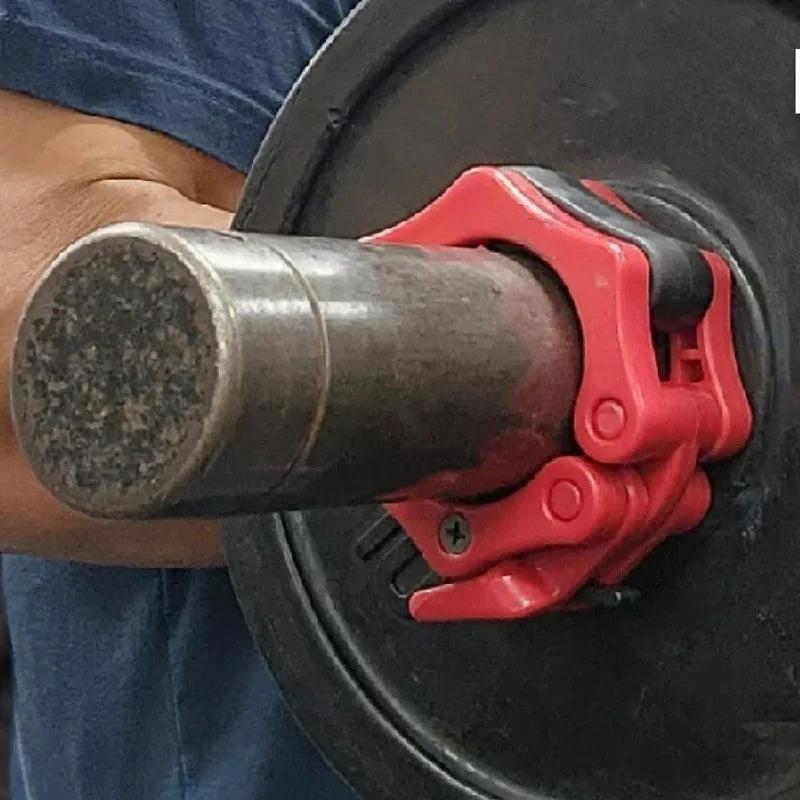
Lever-locking collars that clamp hard and stay clamped. Where spring collars trade grip for speed, quick-release collars provide the clamping force needed for heavy squats, dynamic lifting and any situation where the bar takes impact.
The mechanical difference is straightforward. A spring collar relies on the residual tension of a coiled spring, while a lever collar uses a cam to draw a band tight around the sleeve and lock it. The cam multiplies your hand force considerably, which is why lever collars hold under conditions that would let a spring collar creep along the bar.
That extra security matters most when the bar is moving fast or absorbing impact: cleans, snatches, jerks, dropped deadlifts and bailed squats. It also matters on very heavy asymmetric work, where the consequence of a plate shifting is severe. For light accessory training, the speed of a spring collar is usually preferred.
Use quick-release collars whenever the bar leaves the rack under heavy load or leaves your hands entirely. That covers competition-style squats and deadlifts, all Olympic lifting variations, and any conditioning work where a loaded bar is dropped rather than lowered. Check the lever is fully closed before every heavy set; a partially engaged cam is the one failure mode worth watching for.
Choose quick-release lever collars for heavy and dynamic lifting. Choose spring collars for speed on warm-ups and accessory work. Both fit 50mm Olympic sleeves only. If you own bumper plates and train the Olympic lifts, lever collars should be considered essential rather than optional equipment.
How are these different from spring collars?
A lever cam multiplies your hand force to clamp a band tight around the sleeve, giving far more grip than a spring collar's residual tension.
Do I still need spring collars if I have these?
Many lifters keep both. Springs are quicker for light warm-up sets, lever collars go on for heavy and dynamic work.
Will they fit any Olympic bar?
They fit standard 50mm Olympic sleeves, including barbells, EZ curl bars and trap bars.
Can they be over-tightened?
Close the lever firmly until it seats. Forcing it beyond that point adds nothing and increases wear on the mechanism.
Product Size: 17.4 cm length × 15.3 cm width × 10.1 cm height
Color: sold as a pair (2 collars) in black or red
Clamp Size: 50 mm
Style: Bar Clamp
| Variant | Total weight | Price | Availability | SKU | GTIN | Description |
|---|---|---|---|---|---|---|
| Olympic 2in Barbell Collars, Red Pair, 50mm Weight Clips for Secure Plate Locking on Olympic Barbells | 0.35 kg | £7.99 | Out of stock | BARBELL-CLAMP-RED | 5299481891930 | DescriptionThese Olympic 2 inch barbell collars are supplied as a red pair and are designed for use with standard 50mm Olympic bar sleeves. |
| Olympic 2in Barbell Collars, Black Pair, 50mm Weight Clips for Secure Plate Locking on Olympic Barbells | 0.35 kg | £9.99 | In stock | BARBELL-CLAMP-BLACK | 5299481989095 | DescriptionThese Olympic 2 inch barbell collars are supplied as a black pair and are designed for use with standard 50mm Olympic bar sleeves. |
Wording shared by more than one row above, printed once here rather than repeated in every row.
| Weight | Height | Width | Length | Clamp Size |
|---|---|---|---|---|
| 0.35 kg | 101 mm | 153 mm | 174 mm | 50 mm |
Delivery, returns and warranty are answered in full on the delivery page, in the Help centre and on the warranty page.
| Category | Bars and collars |
|---|---|
| Term | Statutory rights apply; manufacturer terms confirmed on request |
| Covers | Bars that bend beyond their stated tolerance, sleeves that seize, knurling or chrome that fails without impact, collar springs and locks. This guarantee is given by LIFT SETS LTD, Unit at St. Helens, Merseyside, and does not affect your statutory rights under the Consumer Rights Act 2015. |
| Not covered | Bars dropped on safeties or the floor with plates loaded, damage from mismatched sleeves, cosmetic marks. Exclusions never remove your statutory rights: a fault that was present at delivery is covered whatever the exclusions say. |
| How to claim | Email support@liftsets.co.uk with your order number, a description of the fault and two or three photos or a short video. We reply with the next step: replacement part, repair, replacement or refund. Damage or shortages on arrival are a delivery claim, not a warranty claim: tell us as soon as you can. |
Your statutory rights under the Consumer Rights Act 2015 apply in full: up to 30 days to reject a faulty item for a refund, then repair or replacement, and for six months a fault is presumed to have been present at delivery. Full details: Warranty.