
Filters
4 items
Sort Best selling




Description
A kettlebell does something no dumbbell can: it puts the mass below and outside your hand. That offset centre of gravity is the entire point. It turns a swing into a hip-driven ballistic movement, makes a rack position possible, and forces the shoulder and grip to stabilise a load that is constantly trying to rotate. One well-chosen bell delivers strength, conditioning and mobility work from a footprint the size of a dinner plate.
Cast iron or competition?
Cast iron kettlebells grow physically larger as the weight increases. That is the traditional design, it is cheaper, and for most people it is the right call, the bigger bell at heavier weights is not a problem when you are swinging and squatting. Competition kettlebells, by contrast, are steel-shelled and hold identical external dimensions across every weight, so a 16kg and a 32kg sit in the rack position exactly the same way. If you are training the girevoy lifts, long-cycle clean and jerk, snatch, that dimensional consistency genuinely matters, because your technique does not have to change as you move up. If you are swinging, carrying and pressing, cast iron is the better value.
What to look for in a bell?
- Handle finish: smooth and machined, with no casting seam. A rough seam will tear your hands during high-rep snatches.
- Handle diameter: around 33-35mm suits most hands; too thick punishes grip endurance before the target muscles fatigue.
- Window size: enough clearance for two hands on a swing, and for the wrist during a clean.
- Flat, wide base: the bell should sit stable for renegade rows and push-ups without rocking.
- Finish: a powder coat gives grip for chalk-free training; painted gloss finishes get slippery once your hands are damp.
Choosing your first weights
The standard guidance is a 16kg bell for most men and 8kg for most women as an all-round starting point, but the honest version is that swings and presses need very different loads. A weight you can press for five clean reps will feel far too light to swing, and a bell you can swing properly will not press at all early on. Two bells, one lighter for pressing and get-ups, one heavier for swings and squats, is a far more useful first purchase than one compromise weight. Double-bell work later needs matched pairs.
Sets, singles and storage
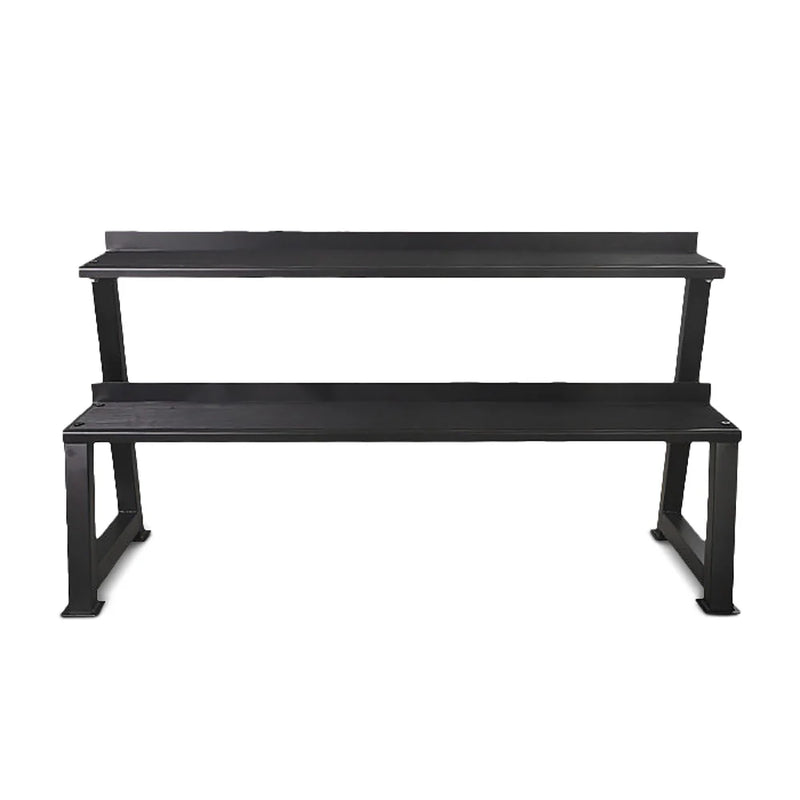
We stock single bells from 4kg to 48kg, matched pairs for double work, and graduated sets. Because kettlebells are dense and get set down hard, storage matters more than people expect: a tiered kettlebell storage rack keeps them off the floor and off your toes. If you swing heavy, put rubber gym flooring under the training area, a dropped 32kg bell will crack a concrete garage slab and destroy a timber floor outright.
Kettlebells combine especially well with slam balls, plyo boxes and weighted vests for conditioning circuits, browse the full functional training range to build the rest of the session.
FAQs
What weight kettlebell should I start with?
As a general guide, 16kg for men and 8kg for women. In practice, swings need a heavier bell than presses, so two bells, one lighter for pressing and get-ups, one heavier for swings and squats, is a more useful first purchase than a single compromise weight.
What is the difference between cast iron and competition kettlebells?
Cast iron bells get physically bigger as the weight increases, and they are the cheaper, more common choice. Competition kettlebells are steel-shelled and identical in size across every weight, so the rack position never changes, which matters for girevoy sport lifts.
Do I need special flooring for kettlebells?
If you swing or snatch heavy, yes. A dropped kettlebell concentrates enormous force on a small area and will crack concrete or destroy timber. Rubber flooring or a dedicated lifting mat under the training area protects both the floor and the bell.
Can kettlebells replace dumbbells?
They overlap but they are not interchangeable. Kettlebells excel at ballistic, hip-driven and carrying work; dumbbells are better for controlled bilateral pressing and isolation. Most complete home gyms end up with both.