10mm Extra-Thick Yoga Mat

£11.49

Showing Black · 1.5 kg in total
In stock
Order by 2pm Mon–Fri, dispatched same dayTotal £10.99 · 1 item
Free GB delivery · Order by 2pm · 180-day returns
Shipped weight 1.5 kg. Delivery to Northern Ireland is charged by order weight: see the weight bands.
Buying 10 or more, or for a gym? Request a trade quote
Training Accessories
The ab wheel is the most demanding core exercise most people will ever attempt, and a double wheel makes it accessible. Two wheels give lateral stability that a single wheel does not, so you can focus on resisting extension rather than fighting to stay straight.
The ab wheel trains something sit-ups do not: anti-extension. As you roll out, gravity attempts to arch your lower back, and your abdominals and lats work isometrically to prevent it. That resisting-motion function is closer to what the core actually does during heavy squats and deadlifts than any crunch variation, which is why the rollout is so widely programmed.
Two wheels rather than one changes the difficulty profile. A single wheel adds a rotational stability demand that, for a beginner, tends to dominate and prevent the exercise being loaded properly. Dual wheels remove that variable so the abdominals are the limiting factor, which is what you want when learning the movement.
Begin from the knees with a short rollout and stop well before your lower back arches. That arch is the failure point of the exercise, not a target. Progress by increasing rollout distance, then by moving the knees further back, and eventually to standing rollouts, which are genuinely advanced and beyond most trained lifters.
Choose a double-wheel roller if you are new to rollouts or want a stable platform to load properly. Choose a single wheel only if you already perform full rollouts and want the additional rotational challenge. Always use the knee pad on hard flooring, and stop the exercise entirely if you feel it in your lower back rather than your abdominals.
Is the ab roller safe for my lower back?
It is safe when performed within your range. The lower back should stay neutral throughout. If it arches, you have rolled out too far, and that is where injury risk begins.
Why two wheels instead of one?
Two wheels remove the rotational stability demand, so the abdominals become the limiting factor rather than your ability to balance. This makes it far more suitable for learning.
How do I make it harder?
Increase the rollout distance, move your knees further back, then progress toward standing rollouts. Standing rollouts are genuinely advanced.
Do I need the knee pad?
On hard flooring, yes. Kneeling on concrete or laminate for a set of rollouts is unpleasant enough to stop you training.
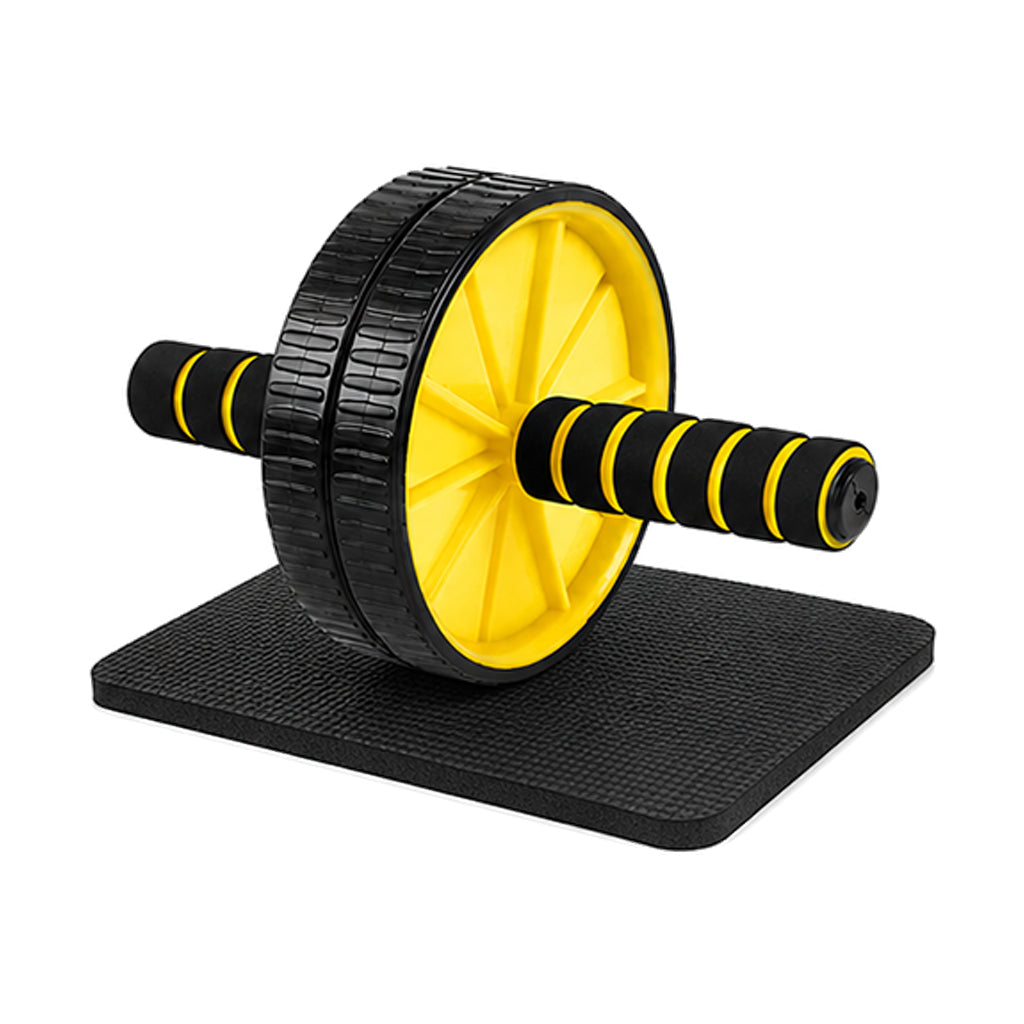
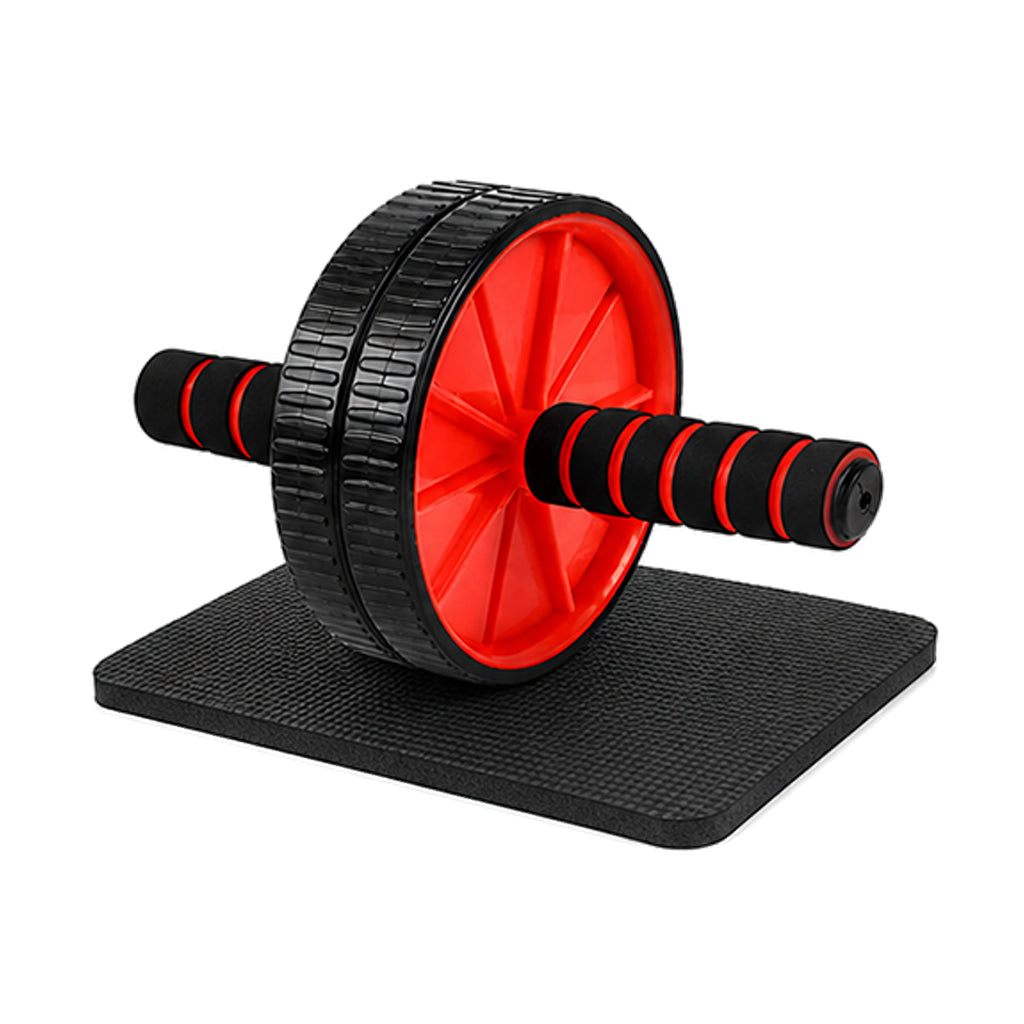
Wheel Diameter: 18.5 cm
Wheel Thickness: 4 cm
Total Width (handle to handle): 25.5 cm
Knee Pad Size: 37.5 cm long × 17 cm wide × 1.5 cm thick
| Variant | Total weight | Price | Availability | SKU | GTIN | Description |
|---|---|---|---|---|---|---|
| Double Wheel Ab Roller with Knee Pad Black Core Strength Training | 1.5 kg | £10.99 | In stock | AB-ROLLER-DW-KP-1 | 5299533626534 | DescriptionThis double black wheel ab roller with knee pad is designed for controlled core and abdominal training. |
| Double Wheel Ab Roller with Knee Pad Blue Core Strength Training | 1.5 kg | £10.99 | In stock | AB-ROLLER-DW-KP-2 | 5299583391055 | DescriptionThis double blue wheel ab roller with knee pad is designed for controlled core and abdominal training. |
| Double Wheel Ab Roller with Knee Pad Yellow Core Strength Training | 1.5 kg | £10.99 | In stock | AB-ROLLER-DW-KP-3 | 5299583927759 | DescriptionThis double yellow wheel ab roller with knee pad is designed for controlled core and abdominal training. |
| Double Wheel Ab Roller with Knee Pad Red Core Strength Training | 1.5 kg | £10.99 | In stock | AB-ROLLER-DW-KP-4 | 5299584177580 | DescriptionThis double red wheel ab roller with knee pad is designed for controlled core and abdominal training. |
Wording shared by more than one row above, printed once here rather than repeated in every row.
Wheel Diameter: 18.5 cm
Wheel Thickness: 4 cm
Total Width (handle to handle): 25.5 cm
Knee Pad Size: 37.5 cm long × 17 cm wide × 1.5 cm thick
Delivery, returns and warranty are answered in full on the delivery page, in the Help centre and on the warranty page.
| Category | Consumables and soft goods |
|---|---|
| Term | Statutory rights apply; manufacturer terms confirmed on request |
| Covers | Manufacturing defects in materials and stitching, foam and rubber that splits or delaminates under normal use. This guarantee is given by LIFT SETS LTD, Unit at St. Helens, Merseyside, and does not affect your statutory rights under the Consumer Rights Act 2015. |
| Not covered | Normal wear, surface marks, fading, stretch in bands and straps, damage from sharp objects or misuse. Exclusions never remove your statutory rights: a fault that was present at delivery is covered whatever the exclusions say. |
| How to claim | Email support@liftsets.co.uk with your order number, a description of the fault and two or three photos or a short video. We reply with the next step: replacement part, repair, replacement or refund. Damage or shortages on arrival are a delivery claim, not a warranty claim: tell us as soon as you can. |
Your statutory rights under the Consumer Rights Act 2015 apply in full: up to 30 days to reject a faulty item for a refund, then repair or replacement, and for six months a fault is presumed to have been present at delivery. Full details: Warranty.
£11.49
From £4.49
From £24.99