10mm Extra-Thick Yoga Mat

£11.49

Showing Pair (2 Dumbbells) / 0.5 kg / Gray · 1 kg the pair
In stock
Order by 2pm Mon–Fri, dispatched same dayTotal £4.49 · 1 item
Free GB delivery · Order by 2pm · 180-day returns
Shipped weight 1 kg the pair. Delivery to Northern Ireland is charged by order weight: see the weight bands.
Buying 10 or more, or for a gym? Request a trade quote
Neoprene Dumbbells
Soft-coated, colour-coded and quiet. Neoprene dumbbells are the standard for class-based training, rehabilitation and high-repetition conditioning, where the priority is comfort in the hand and equipment that will not damage a studio floor or roll under a bench.
Neoprene serves a specific purpose. The coating grips a dry or sweaty palm without knurling, which matters enormously in high-repetition work where a knurled steel handle would tear skin over dozens of sets. It is also warm to the touch, which is why neoprene dominates rehabilitation and older-adult exercise settings where cold cast iron is genuinely unpleasant to hold.
The format's ceiling is low by design. Neoprene dumbbells are typically produced in light increments because the coating and the moulded profile are not intended for heavy pressing. That is a feature rather than a fault. For a group exercise class, a Pilates studio or a physiotherapy clinic, a spread of light colour-coded pairs is far more useful than a small number of heavy bells.
These excel in high-repetition and controlled-tempo contexts: lateral raises, front raises, rear-delt flies, bicep curls, tricep kickbacks, weighted Pilates sequences and rehabilitation protocols for the shoulder and elbow. They also work well for loaded carries and marching drills in circuit formats, where a hex dumbbell's corners would be uncomfortable against the leg.
Choose neoprene if your training is high-repetition, class-based, rehabilitative, or shared with users who need a comfortable grip. Choose hex dumbbells if you are pressing and rowing for strength, where you need heavier loads and a knurled handle. Many home gyms end up with both: a light neoprene spread for accessory and warm-up work, and hex or adjustable dumbbells for the heavy lifting.
What is inside a neoprene dumbbell?
A cast iron core with a moulded neoprene coating bonded over it. The coating provides grip, colour coding and floor protection.
Are neoprene dumbbells suitable for building strength?
They are best for high-repetition and accessory work. For heavy pressing and rowing, hex or adjustable dumbbells offer the loads you need.
Will they mark a wooden floor?
The coating is far kinder to flooring than bare iron, which is why neoprene is standard in studios. They are also noticeably quieter.
Do they come as a pair?
Yes, these are supplied in pairs so you can train both sides immediately.
| Variant | Weight (each) | Pair total | Price | Availability | SKU | GTIN | Description |
|---|---|---|---|---|---|---|---|
| Neoprene Dumbbell Pair 0.5kg Pink Soft Grip Weights for Home Fitness | 0.5 kg | 1 kg | £4.49 | Out of stock | Neoprene-2x-0.5KG | 5299449567839 | DescriptionThis 0.5kg pink neoprene dumbbell pair is ideal for light resistance training, toning, rehabilitation and fitness exercises. |
| Neoprene Dumbbell Pair 0.5kg Gray Soft Grip Weights for Home Fitness | 0.5 kg | 1 kg | £4.49 | In stock | Neoprene-2x-0.5KG-GRY | 5299450239022 | DescriptionThis 0.5kg gray neoprene dumbbell pair is ideal for light resistance training, toning, rehabilitation and fitness exercises. |
| Neoprene Dumbbell Pair 0.5kg Blue Soft Grip Weights for Home Fitness | 0.5 kg | 1 kg | £4.49 | In stock | Neoprene-2x-0.5KG-BLU | 5299450240622 | DescriptionThis 0.5kg blue neoprene dumbbell pair is ideal for light resistance training, toning, rehabilitation and fitness exercises. |
| Neoprene Dumbbell Pair 1kg Pink Soft Grip Weights for Home Fitness | 1.0 kg | 2 kg | £7.99 | In stock | Neoprene-2x-1KG | 5299449978420 | DescriptionThis 1kg pink neoprene dumbbell pair is ideal for light resistance training, toning, rehabilitation and fitness exercises. |
| Neoprene Dumbbell Pair 1kg Gray Soft Grip Weights for Home Fitness | 1.0 kg | 2 kg | £7.99 | In stock | Neoprene-2x-1KG-GRY | 5299450591793 | DescriptionThis 1kg gray neoprene dumbbell pair is ideal for light resistance training, toning, rehabilitation and fitness exercises. |
| Neoprene Dumbbell Pair 1kg Blue Soft Grip Weights for Home Fitness | 1.0 kg | 2 kg | £7.99 | In stock | Neoprene-2x-1KG-BLU | 5299450599409 | DescriptionThis 1kg blue neoprene dumbbell pair is ideal for light resistance training, toning, rehabilitation and fitness exercises. |
| Neoprene Dumbbell Pair 1.5kg Pink Soft Grip Weights for Home Fitness | 1.5 kg | 3 kg | £9.49 | In stock | Neoprene-2x-1.5KG-PNK | 5299451461941 | DescriptionThis 1.5kg pink neoprene dumbbell pair is ideal for light resistance training, toning, rehabilitation and fitness exercises. |
| Neoprene Dumbbell Pair 1.5kg Blue Soft Grip Weights for Home Fitness | 1.5 kg | 3 kg | £9.49 | In stock | Neoprene-2x-1.5KG-BLU | 5299451537110 | DescriptionThis 1.5kg blue neoprene dumbbell pair is ideal for light resistance training, toning, rehabilitation and fitness exercises. |
| Neoprene Dumbbell Pair 1.5kg Purple Soft Grip Weights for Home Fitness | 1.5 kg | 3 kg | £9.49 | In stock | Neoprene-2x-1.5KG-PUR | 5299451601248 | DescriptionThis 1.5kg purple neoprene dumbbell pair is ideal for light resistance training, toning, rehabilitation and fitness exercises. |
| Neoprene Dumbbell Pair 2kg Pink Soft Grip Weights for Home Fitness | 2.0 kg | 4 kg | £11.49 | In stock | Neoprene-2x-2KG-PNK | 5299451757075 | DescriptionThis 2kg pink neoprene dumbbell pair is ideal for light resistance training, toning, rehabilitation and fitness exercises. |
| Neoprene Dumbbell Pair 2kg Blue Soft Grip Weights for Home Fitness | 2.0 kg | 4 kg | £11.49 | In stock | Neoprene-2x-2KG-BLU | 5299452168184 | DescriptionThis 2kg blue neoprene dumbbell pair is ideal for light resistance training, toning, rehabilitation and fitness exercises. |
| Neoprene Dumbbell Pair 2.5kg Pink Soft Grip Weights for Home Fitness | 2.5 kg | 5 kg | £12.99 | In stock | Neoprene-2x-2.5KG-PNK | 5299452205605 | DescriptionThis 2.5kg pink neoprene dumbbell pair is ideal for light resistance training, toning, rehabilitation and fitness exercises. |
| Neoprene Dumbbell Pair 2.5kg Blue Soft Grip Weights for Home Fitness | 2.5 kg | 5 kg | £12.99 | In stock | Neoprene-2x-2.5KG-BLU | 5299452320612 | DescriptionThis 2.5kg blue neoprene dumbbell pair is ideal for light resistance training, toning, rehabilitation and fitness exercises. |
| Neoprene Dumbbell Pair 3kg Pink Soft Grip Weights for Home Fitness | 3.0 kg | 6 kg | £14.99 | In stock | Neoprene-2x-3KG-PNK | 5299452757166 | DescriptionThis 3kg pink neoprene dumbbell pair is ideal for light resistance training, toning, rehabilitation and fitness exercises. |
| Neoprene Dumbbell Pair 3kg Blue Soft Grip Weights for Home Fitness | 3.0 kg | 6 kg | £14.99 | In stock | Neoprene-2x-3KG-BLU | 5299452815620 | DescriptionThis 3kg blue neoprene dumbbell pair is ideal for light resistance training, toning, rehabilitation and fitness exercises. |
| Neoprene Dumbbell Pair 4kg Pink Soft Grip Weights for Home Fitness | 4.0 kg | 8 kg | £18.49 | In stock | Neoprene-2x-4KG-PNK | 5299452888273 | DescriptionThis 4kg pink neoprene dumbbell pair is ideal for light resistance training, toning, rehabilitation and fitness exercises. |
| Neoprene Dumbbell Pair 4kg Blue Soft Grip Weights for Home Fitness | 4.0 kg | 8 kg | £18.49 | In stock | Neoprene-2x-4KG-BLU | 5299452905857 | DescriptionThis 4kg blue neoprene dumbbell pair is ideal for light resistance training, toning, rehabilitation and fitness exercises. |
| Neoprene Dumbbell Pair 5kg Pink Soft Grip Weights for Home Fitness | 5.0 kg | 10 kg | £21.99 | In stock | Neoprene-2x-5KG-PNK | 5299454911320 | DescriptionThis 5kg pink neoprene dumbbell pair is ideal for light resistance training, toning, rehabilitation and fitness exercises. |
| Neoprene Dumbbell Pair 5kg Blue Soft Grip Weights for Home Fitness | 5.0 kg | 10 kg | £21.99 | In stock | Neoprene-2x-5KG-BLU | 5299527373598 | DescriptionThis 5kg blue neoprene dumbbell pair is ideal for light resistance training, toning, rehabilitation and fitness exercises. |
| Neoprene Dumbbell Pair 6kg Blue Soft Grip Weights for Home Fitness | 6.0 kg | 12 kg | £28.89 | In stock | Neoprene-2x-6KG-BLU | 5299576944190 | DescriptionThis 6kg blue neoprene dumbbell pair is ideal for light resistance training, toning, rehabilitation and fitness exercises. |
| Neoprene Dumbbell Pair 6kg Purple Soft Grip Weights for Home Fitness | 6.0 kg | 12 kg | £28.89 | In stock | Neoprene-2x-6KG-PUR | 5299578082418 | DescriptionThis 6kg purple neoprene dumbbell pair is ideal for light resistance training, toning, rehabilitation and fitness exercises. |
| Neoprene Dumbbell Pair 7kg Gray Soft Grip Weights for Home Fitness | 7.0 kg | 14 kg | £33.98 | In stock | Neoprene-2x-7KG-GRY | 5299578236538 | DescriptionThis 7kg gray neoprene dumbbell pair is ideal for light resistance training, toning, rehabilitation and fitness exercises. |
| Neoprene Dumbbell Pair 7kg Blue Soft Grip Weights for Home Fitness | 7.0 kg | 14 kg | £33.98 | In stock | Neoprene-2x-7KG-BLU | 5299579321363 | DescriptionThis 7kg blue neoprene dumbbell pair is ideal for light resistance training, toning, rehabilitation and fitness exercises. |
| Neoprene Dumbbell Pair 7kg Purple Soft Grip Weights for Home Fitness | 7.0 kg | 14 kg | £33.98 | In stock | Neoprene-2x-7KG-PUR | 5299579487533 | DescriptionThis 7kg purple neoprene dumbbell pair is ideal for light resistance training, toning, rehabilitation and fitness exercises. |
| Neoprene Dumbbell Pair 8kg Blue Soft Grip Weights for Home Fitness | 8.0 kg | 16 kg | £38.49 | In stock | Neoprene-2x-8KG-BLU | 5299579907086 | DescriptionThis 8kg blue neoprene dumbbell pair is ideal for light resistance training, toning, rehabilitation and fitness exercises. |
| Neoprene Dumbbell Pair 9kg Red Soft Grip Weights for Home Fitness | 9.0 kg | 18 kg | £43.29 | In stock | Neoprene-2x-9KG-RED | 5299579995588 | DescriptionThis 9kg red neoprene dumbbell pair is ideal for light resistance training, toning, rehabilitation and fitness exercises. |
| Neoprene Dumbbell Pair 10kg Black Soft Grip Weights for Home Fitness | 10.0 kg | 20 kg | £47.99 | In stock | Neoprene-2x-10KG-BLK | 5299580253776 | DescriptionThis 10kg black neoprene dumbbell pair is ideal for light resistance training, toning, rehabilitation and fitness exercises. |
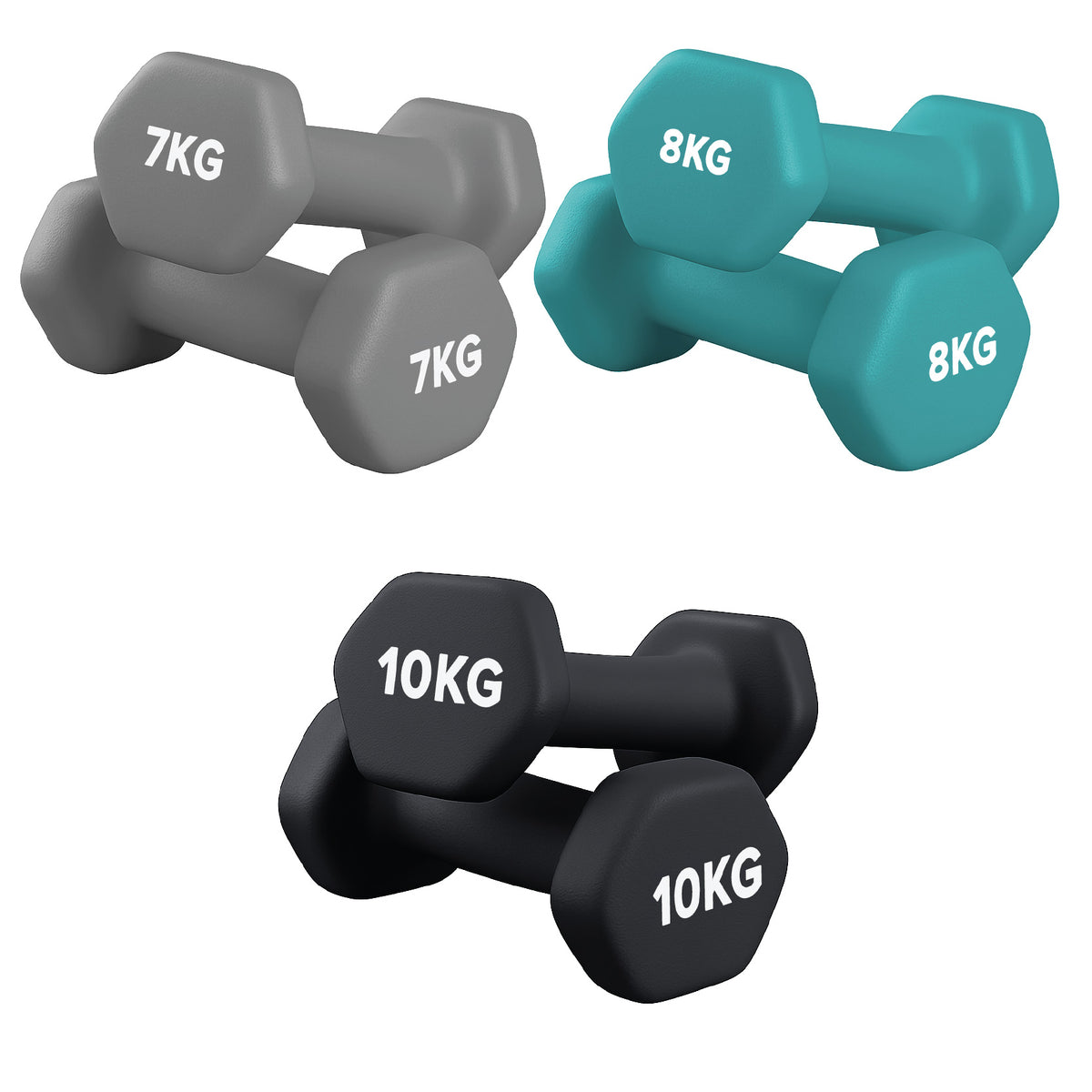
| Neoprene Dumbbell Set, 3 Pairs (6kg, 7kg & 8kg) Soft-Grip Anti-Roll Hand Weights for Home Fitness | 6-8kg (3 Pairs 42kg) | 42 kg | £86.49 | In stock | NEOPRENE-6-8-3P-42kg | 5299453362734 | DescriptionThis neoprene dumbbell set includes 3 pairs of hand weights ranging from 6kg to 8kg, with a total combined weight of 42kg. Each dumbbell features a soft-touch neoprene coating for a comfortable, non-slip grip and an anti-roll design to improve safety during training. Ideal for strength training, conditioning, circuit workouts and functional fitness, this durable set is suitable for home gyms, studios and light commercial fitness environments. |
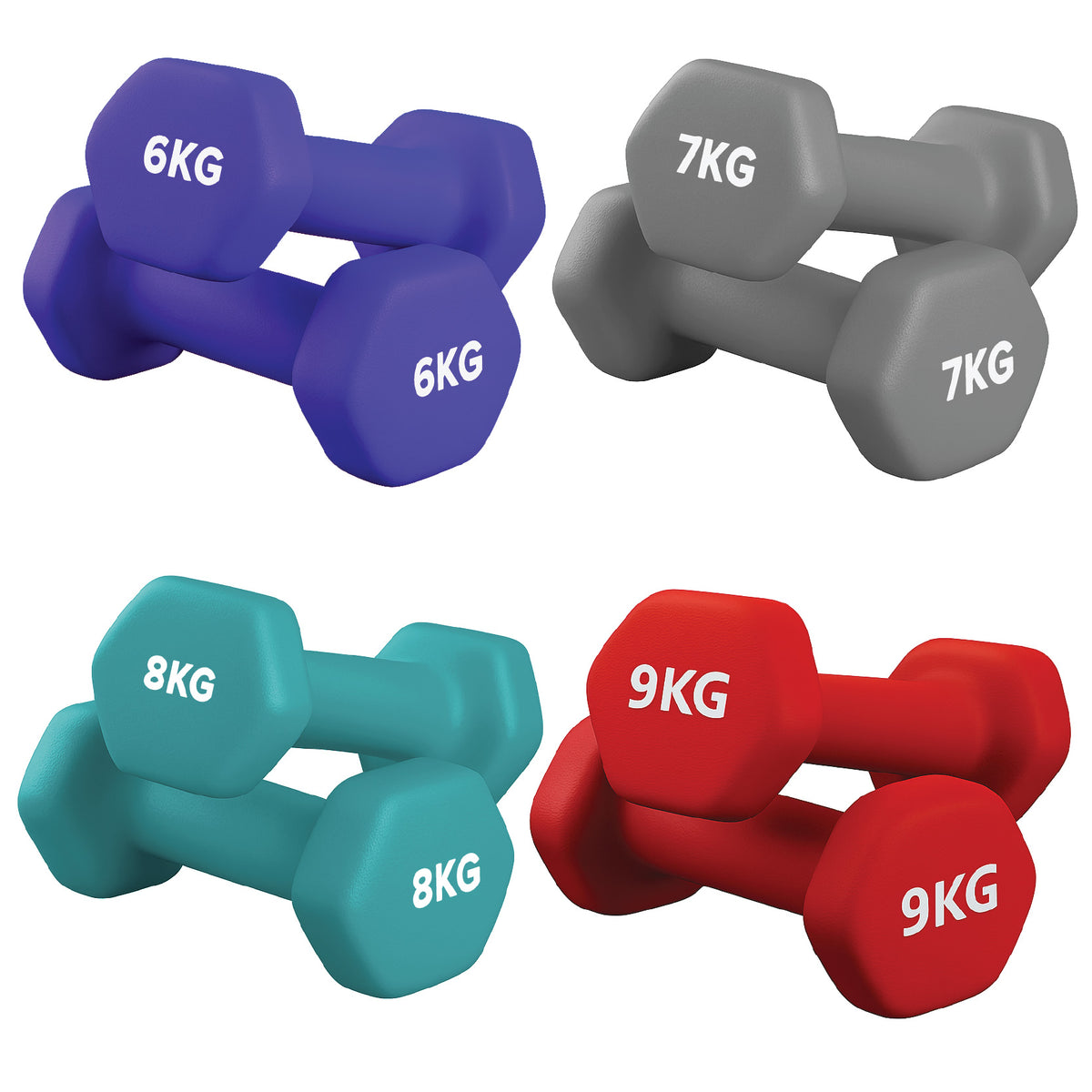
| Neoprene Dumbbell Set, 3 Pairs (6kg, 7kg & 9kg) Soft-Grip Anti-Roll Hand Weights for Home Fitness | 6-9kg (3 Pairs 44kg) | 44 kg | £93.49 | In stock | NEOPRENE-6-9-3P-44kg | 5299453523203 | DescriptionThis neoprene dumbbell set includes 3 pairs of weights ranging from 6kg to 9kg, with a total combined weight of 44kg. Each dumbbell is coated in soft-touch neoprene for enhanced comfort, sweat resistance and a secure non-slip grip. The anti-roll hex-style design improves safety and storage convenience. Ideal for strength training, toning, HIIT, functional workouts and rehabilitation, this versatile set is perfect for home gyms, fitness studios and light commercial use. |
| 7–10kg Neoprene Dumbbell Pairs (3 Pairs), Home Training, Multi-Weight Set for Strength | 7-10kg (3 Pairs) | 54 kg | £128.99 | In stock | NEOPRENE-7-10-3P-54kg | 5299453968974 | DescriptionThis multi-pair neoprene dumbbell set includes three pairs ranging from 7kg to 10kg, with a combined weight of 54kg. Each dumbbell features a durable steel core with a neoprene coating for improved grip, comfort, and floor protection. Ideal for progressive strength training, circuits, and home gyms, the varied weights suit intermediate to advanced users targeting controlled, repeatable workouts. |
| 6–9kg Neoprene Dumbbell Pairs (4 Pairs), Home Training, Multi-Weight 60kg Set | 6-9kg (4 Pairs 60kg) | 60 kg | £143.99 | In stock | NEOPRENE-6-9-4P-60kg | 5299454416931 | DescriptionThis neoprene dumbbell set includes four pairs ranging from 6kg to 9kg, with a combined total weight of 60kg. Each dumbbell is built around a solid steel core and finished with a neoprene coating to enhance grip comfort while helping protect floors. Designed for progressive resistance training, the multiple weight options suit home gyms, circuits, and structured strength programmes for intermediate users. |
Wording shared by more than one row above, printed once here rather than repeated in every row.
| Weight | Height | Length | Width |
|---|---|---|---|
| 1 kg | 70 mm | 160 mm | 70 mm |
| 1.5 kg | 70 mm | 160 mm | 70 mm |
| 2 kg | 70 mm | 170 mm | 70 mm |
| 2.5 kg | 80 mm | 180 mm | 70 mm |
| 3 kg | 80 mm | 180 mm | 80 mm |
| 4 kg | 90 mm | 190 mm | 90 mm |
| 5 kg | 90 mm | 200 mm | 90 mm |
| 6 kg | 100 mm | 210 mm | 90 mm |
| 7 kg | 100 mm | 220 mm | 90 mm |
| 8 kg | 110 mm | 230 mm | 100 mm |
| 9 kg | 110 mm | 240 mm | 100 mm |
| 10 kg | 120 mm | 250 mm | 110 mm |
Delivery, returns and warranty are answered in full on the delivery page, in the Help centre and on the warranty page.
| Category | Free weights |
|---|---|
| Term | Statutory rights apply; manufacturer terms confirmed on request |
| Covers | Casting defects, coating that lifts or cracks without impact, handles that come loose from the head, adjustable mechanisms that fail under normal use. This guarantee is given by LIFT SETS LTD, Unit at St. Helens, Merseyside, and does not affect your statutory rights under the Consumer Rights Act 2015. |
| Not covered | Chips and scuffs from dropping, rust from wet storage, cosmetic marks, use in commercial settings unless quoted. Exclusions never remove your statutory rights: a fault that was present at delivery is covered whatever the exclusions say. |
| How to claim | Email support@liftsets.co.uk with your order number, a description of the fault and two or three photos or a short video. We reply with the next step: replacement part, repair, replacement or refund. Damage or shortages on arrival are a delivery claim, not a warranty claim: tell us as soon as you can. |
Your statutory rights under the Consumer Rights Act 2015 apply in full: up to 30 days to reject a faulty item for a refund, then repair or replacement, and for six months a fault is presumed to have been present at delivery. Full details: Warranty.
£11.49
£10.99
£19.99