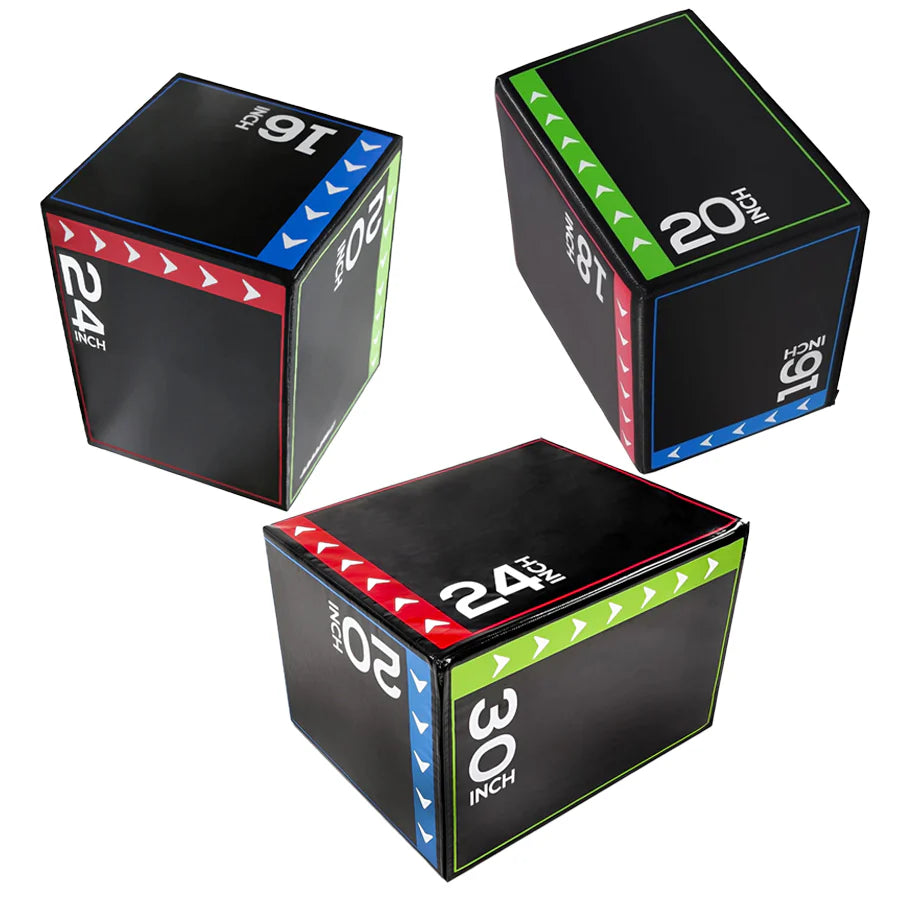
Wooden Plyo Jump Box

From £31.99

Showing Small (16x18x20) · 14.5 kg in total
In stock
Order by 2pm Mon–Fri, dispatched same dayPay in 3 interest-free instalments of £18.33 with Klarna. 18+, T&Cs apply, credit subject to status. Late fees may apply.
Total £54.99 · 1 item
Free GB delivery · Order by 2pm · 180-day returns
Shipped weight 14.5 kg. Delivery to Northern Ireland is charged by order weight: see the weight bands.
Buying 10 or more, or for a gym? Request a trade quote
Conditioning
Every experienced athlete has a story about a wooden plyo box and a shin. A soft foam box removes that risk entirely, which is why foam has become standard in commercial conditioning studios and why it is the sensible choice for training alone at home.
The case for foam is straightforward risk management. A missed box jump on a plywood box means a shin striking a hard edge at speed, which is one of the more unpleasant injuries in training. A foam box compresses on contact, so a missed rep is a bruise rather than a hospital visit. That difference is why foam boxes dominate commercial group training floors.
The trade-off is compression under load. Foam gives slightly on landing, which means the effective height varies a little and the surface is less rigid than plywood. For pure box jump training this is unimportant. For heavy loaded step-ups, a rigid wooden box gives a more consistent platform.
Three heights in one unit covers the full progression: a low setting for step-ups, box squats and beginners, a mid setting for standard box jumps, and a high setting for advanced plyometrics. Box jumps train rate of force development and reactive strength, while step-ups and box squats provide unilateral strength and a controlled depth reference for squatting.
Choose the soft box if you train alone, coach beginners, or jump at heights where a miss would be costly. Choose the wooden box if you want maximum rigidity for loaded step-ups and box squats, or prefer the traditional feel. Whichever you choose, always step down from a box rather than jumping down, as repeated depth landings accumulate a lot of joint stress.
Is a soft box less stable than a wooden one?
A well-constructed foam box has a wide stable base and will not tip. It does compress slightly on landing, which makes it marginally less rigid but far safer on a missed jump.
What are the three heights?
The box is rotated onto a different face for each height. Check the stated dimensions on the page for the exact measurements.
Can I do loaded step-ups on it?
Yes, though foam compresses under load. For heavy loaded step-ups a rigid wooden box gives a more consistent platform.
Should I jump down from the box?
No. Step down. Repeated depth landings place high stress on knees, ankles and Achilles tendons for very little training benefit.
Available 3-in-1 Size Options:
Small: Offers three training heights with its compact build of 16" × 18" × 20" (approx. 40.6 × 45.7 × 50.8 cm).
Medium: Designed for intermediate jump work, giving you 16" × 20" × 24" orientations (around 40.6 × 50.8 × 61.0 cm).
Large: Our most advanced option, providing 20" × 24" × 30" height variations (roughly 50.8 × 61.0 × 76.2 cm) for powerful plyometric training.
| Variant | Total weight | Price | Availability | SKU | GTIN | Description |
|---|---|---|---|---|---|---|
| 3-in-1 Soft Plyo Jump Box, Small (16x18x20) Training Box for Jump, Strength & Conditioning Workouts | 14.5 kg | £54.99 | In stock | S-Soft-Jump-Box | 5299521875173 | DescriptionThis 3-in-1 Soft Plyo Jump Box in the small (16x18x20) size provides versatile height options for plyometric, strength and conditioning training. |
| 3-in-1 Soft Plyo Jump Box, Medium (16x20x24) Training Box for Jump, Strength & Conditioning Workouts | 18.8 kg | £64.99 | Out of stock | M-Soft-Jump-Box | 5299521923058 | DescriptionThis 3-in-1 Soft Plyo Jump Box in the medium (16x20x24) size provides versatile height options for plyometric, strength and conditioning training. |
| 3-in-1 Soft Plyo Jump Box, Large (20x24x30) Training Box for Jump, Strength & Conditioning Workouts | 35 kg | £99.99 | Out of stock | L-Soft-Jump-Box | 5299522368155 | DescriptionThis 3-in-1 Soft Plyo Jump Box in the large (20x24x30) size provides versatile height options for plyometric, strength and conditioning training. |
| 3-in-1 Soft Plyo Jump Box Set, Complete Multi-Height Foam Plyometric Boxes for Safe Jump | 68.3 kg | £219.99 | In stock | Soft-Jump-Box-SET | 5299522382793 | DescriptionThis 3-in-1 Soft Plyo Jump Box Set provides a full collection of multi-height boxes for progressive plyometric and strength training. Each box features a firm foam core to reduce impact and lessen the risk of shin injuries, with a durable non-slip cover for stability during jumps and step-ups. Ideal for athletes and home gym users, this set enables varied training intensities for developing power, speed, balance and lower-body strength. |
Wording shared by more than one row above, printed once here rather than repeated in every row.
| Box | Weight | Diameter |
|---|---|---|
| Small | 14.5 kg | 16″ × 18″ × 20″ |
| Medium | 18.8 kg | 16″ × 20″ × 24″ |
| Large | 35 kg | 20″ × 24″ × 30″ |
Delivery, returns and warranty are answered in full on the delivery page, in the Help centre and on the warranty page.
| Category | Consumables and soft goods |
|---|---|
| Term | Statutory rights apply; manufacturer terms confirmed on request |
| Covers | Manufacturing defects in materials and stitching, foam and rubber that splits or delaminates under normal use. This guarantee is given by LIFT SETS LTD, Unit at St. Helens, Merseyside, and does not affect your statutory rights under the Consumer Rights Act 2015. |
| Not covered | Normal wear, surface marks, fading, stretch in bands and straps, damage from sharp objects or misuse. Exclusions never remove your statutory rights: a fault that was present at delivery is covered whatever the exclusions say. |
| How to claim | Email support@liftsets.co.uk with your order number, a description of the fault and two or three photos or a short video. We reply with the next step: replacement part, repair, replacement or refund. Damage or shortages on arrival are a delivery claim, not a warranty claim: tell us as soon as you can. |
Your statutory rights under the Consumer Rights Act 2015 apply in full: up to 30 days to reject a faulty item for a refund, then repair or replacement, and for six months a fault is presumed to have been present at delivery. Full details: Warranty.
From £31.99
From £7.99
From £7.99