30kg Adjustable Weighted Vest

£94.99

Showing 3kg · 3 kg in total
In stock
Order by 2pm Mon–Fri, dispatched same dayTotal £31.99 · 1 item
Free GB delivery · Order by 2pm · 180-day returns
Shipped weight 3 kg. Delivery to Northern Ireland is charged by order weight: see the weight bands.
Buying 10 or more, or for a gym? Request a trade quote
Conditioning
A wall ball has to do something no other weight does: absorb a full-force throw and be caught again, hundreds of times, without splitting. Reinforced double stitching and a soft shell are what separate a ball that lasts a year from one that lasts a month.
The seam is the failure point on every wall ball ever made. Each throw sends the filling outward against the stitching, and cheap single-stitched balls split along a seam within weeks of regular use. Double stitching and a reinforced panel construction are the specifications worth paying for, because a burst wall ball is not repairable.
Consistent outer diameter across weights is the second thing to look for. If your 6kg and 9kg balls differ in size, the release point and the target height change as you progress, which undermines the whole point of a standardised movement. Matched diameters keep the movement identical whatever load you use.
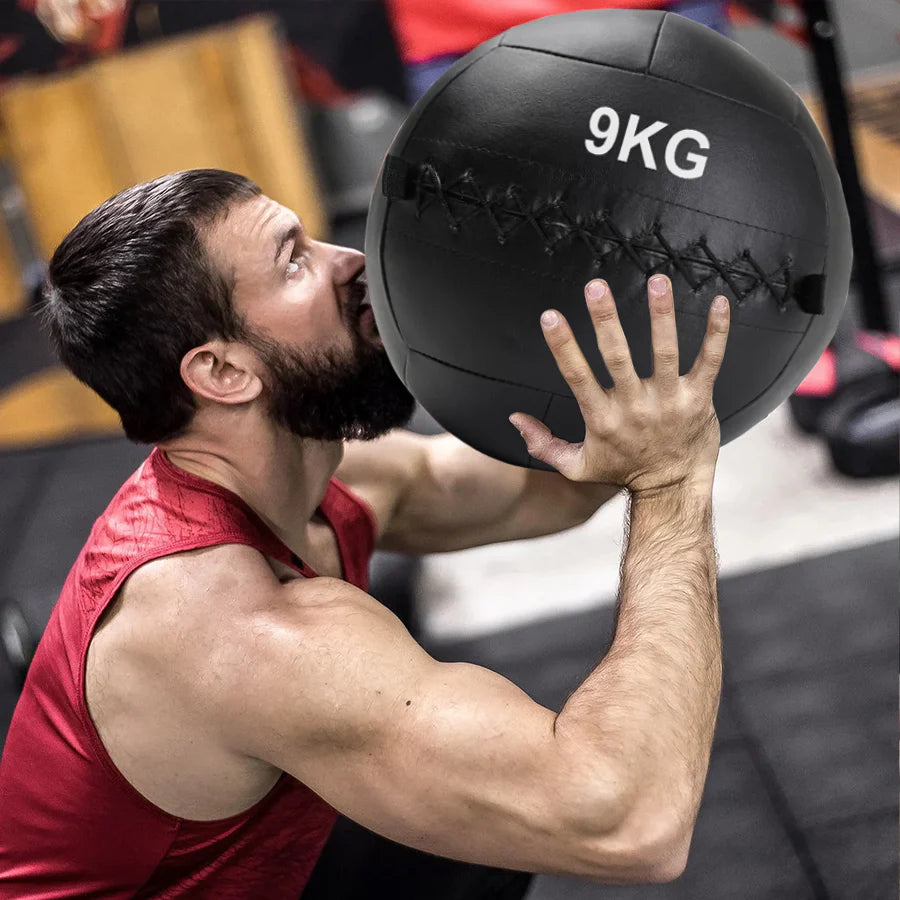
The wall ball shot is the signature movement: a front squat into an explosive overhead throw at a target, catching on the way down into the next rep. It is one of the most metabolically demanding movements available and trains triple extension, overhead mechanics and conditioning simultaneously. Wall balls also serve for slams, rotational throws, partner passes and weighted sit-ups.
Choose a wall ball if you want conditioning work that trains power output rather than just heart rate. As a rough guide, 6kg to 9kg suits most beginners, with 9kg and 12kg for stronger athletes. Choose slam balls instead if you want to throw down hard rather than up, since slam balls are built for ground impact and do not rebound.
What weight wall ball should I use?
Many beginners work well with 6kg, progressing to 9kg. Stronger athletes commonly use 9kg or 12kg. Pick a weight you can throw to target height for at least ten unbroken repetitions.
What is the difference between a wall ball and a slam ball?
A wall ball is soft-shelled and designed to be thrown upward and caught. A slam ball is dense, does not rebound and is designed to be thrown down onto the floor.
Will it damage my wall?
Repeated impacts mark plaster and can loosen fixings. Use a solid masonry wall or a dedicated target, and avoid throwing at stud partitions.
Can I use it as a medicine ball?
Yes, for throws, rotational work and weighted core movements. It is softer and larger than a traditional medicine ball, which suits catching.
| Variant | Weight | Total weight | Price | Availability | SKU | GTIN | Description |
|---|---|---|---|---|---|---|---|
| Wall Ball 3kg, Durable Weighted Wall Ball for Strength, Core, Cross Training & Conditioning Workouts | 3.0kg | 3 kg | £31.99 | In stock | 3KG-WALL-BALL | 5299508015677 | DescriptionThis 3kg wall ball is designed for functional strength, conditioning and full-body training. |
| Wall Ball 4kg, Durable Weighted Wall Ball for Strength, Core, Cross Training & Conditioning Workouts | 4.0kg | 4 kg | £32.99 | In stock | 4KG-WALL-BALL | 5299508096447 | DescriptionThis 4kg wall ball is designed for functional strength, conditioning and full-body training. |
| Wall Ball 6kg, Durable Weighted Wall Ball for Strength, Core, Cross Training & Conditioning Workouts | 6.0kg | 6 kg | £34.99 | In stock | 6KG-WALL-BALL | 5299508305112 | DescriptionThis 6kg wall ball is designed for functional strength, conditioning and full-body training. |
| Wall Ball 9kg, Durable Weighted Wall Ball for Strength, Core, Cross Training & Conditioning Workouts | 9.0kg | 9 kg | £42.99 | In stock | 9KG-WALL-BALL | 5299508509152 | DescriptionThis 9kg wall ball is designed for functional strength, conditioning and full-body training. |
| Wall Ball 12kg, Durable Weighted Wall Ball for Strength, Core, Cross Training & Conditioning Workouts | 12.0kg | 12 kg | £46.99 | In stock | 12KG-WALL-BALL | 5299509115666 | DescriptionThis 12kg wall ball is designed for functional strength, conditioning and full-body training. |
| Wall Ball 3 Ball Set (13kg), Durable Weighted Wall Ball for Strength, Core, Cross Training & Conditioning Workouts | 3 Ball Set (13.0kg) | 13 kg | £99.99 | In stock | WALL-BALL-SET-13KG-3B | 5299509471939 | DescriptionThis 3 Ball Set (13kg) wall ball is designed for functional strength, conditioning and full-body training. |
| Wall Ball 3 Ball Set (18kg), Durable Weighted Wall Ball for Strength, Core, Cross Training & Conditioning Workouts | 3 Ball Set (18.0kg) | 18 kg | £109.99 | In stock | WALL-BALL-SET-18KG-3B | 5299510076468 | DescriptionThis 3 Ball Set (18kg) wall ball is designed for functional strength, conditioning and full-body training. |
| Wall Ball 4 Ball Set (30kg), Durable Weighted Wall Ball for Strength, Core, Cross Training & Conditioning Workouts | 4 Ball Set (30.0kg) | 30 kg | £156.99 | In stock | WALL-BALL-SET-30KG-4B | 5299510204854 | DescriptionThis 4 Ball Set (30kg) wall ball is designed for functional strength, conditioning and full-body training. |
| Wall Ball 5 Ball Set (34kg), Durable Weighted Wall Ball for Strength, Core, Cross Training & Conditioning Workouts | 5 Ball Set (34.0kg) | 34 kg | £189.99 | In stock | WALL-BALL-SET-34KG-5B | 5299510336593 | DescriptionThis 5 Ball Set (34kg) wall ball is designed for functional strength, conditioning and full-body training. |
Wording shared by more than one row above, printed once here rather than repeated in every row.
| Weight | Diameter Of Wall Ball |
|---|---|
| 3 kg | 240 mm |
| 4 kg | 240 mm |
| 6 kg | 250 mm |
| 9 kg | 250 mm |
| 12 kg | 250 mm |
Delivery, returns and warranty are answered in full on the delivery page, in the Help centre and on the warranty page.
| Category | Consumables and soft goods |
|---|---|
| Term | Statutory rights apply; manufacturer terms confirmed on request |
| Covers | Manufacturing defects in materials and stitching, foam and rubber that splits or delaminates under normal use. This guarantee is given by LIFT SETS LTD, Unit at St. Helens, Merseyside, and does not affect your statutory rights under the Consumer Rights Act 2015. |
| Not covered | Normal wear, surface marks, fading, stretch in bands and straps, damage from sharp objects or misuse. Exclusions never remove your statutory rights: a fault that was present at delivery is covered whatever the exclusions say. |
| How to claim | Email support@liftsets.co.uk with your order number, a description of the fault and two or three photos or a short video. We reply with the next step: replacement part, repair, replacement or refund. Damage or shortages on arrival are a delivery claim, not a warranty claim: tell us as soon as you can. |
Your statutory rights under the Consumer Rights Act 2015 apply in full: up to 30 days to reject a faulty item for a refund, then repair or replacement, and for six months a fault is presumed to have been present at delivery. Full details: Warranty.
£94.99
From £7.99
From £7.99