Wooden Plyo Jump Box

From £31.99

Showing 3kg · 3 kg in total
Out of stock
Order by 2pm Mon–Fri, dispatched same dayTotal £9.99 · 1 item
Free GB delivery · Order by 2pm · 180-day returns
Shipped weight 3 kg. Delivery to Northern Ireland is charged by order weight: see the weight bands.
Buying 10 or more, or for a gym? Request a trade quote
Conditioning
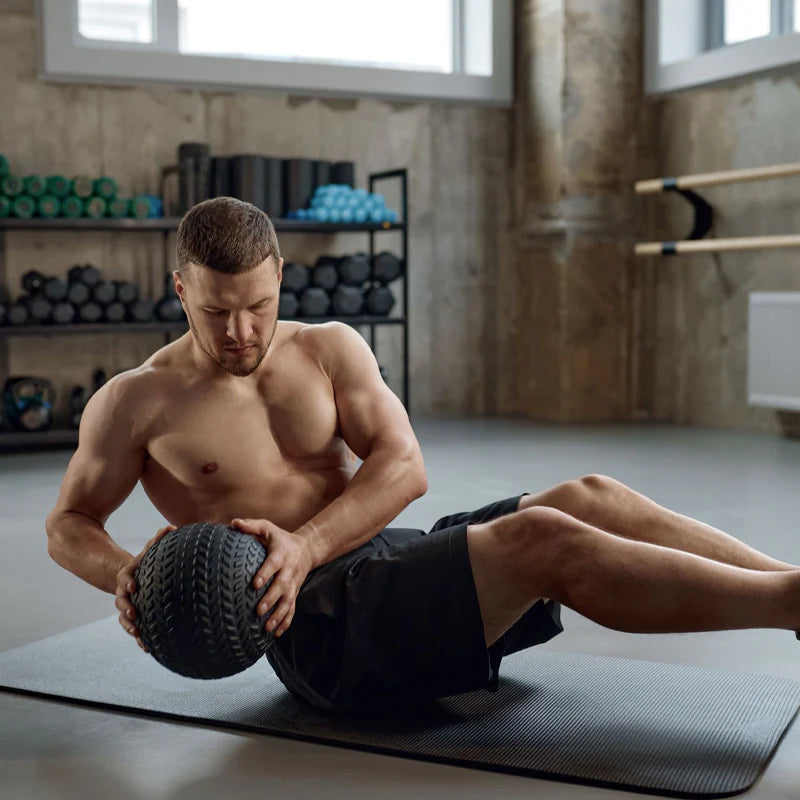
A slam ball that bounces is dangerous. These use a dense dead fill and a tyre-tread outer surface so the ball stops where it lands, and so a sweaty grip still holds through an overhead throw.
Dead bounce is the defining safety feature. A slam ball with any rebound returns toward your face at the speed you threw it, which is why sand-filled dead-fill construction is standard. The fill also lets the ball deform slightly on impact, spreading force across a wider area and reducing the shock transmitted into the floor.
The tread pattern is not decoration. Slams are performed at maximum effort, usually late in a session when hands are wet, and a smooth rubber ball becomes genuinely difficult to hold overhead. A moulded tread gives the fingers something to catch on, which is the difference between a controlled throw and a ball leaving your hands early.
The ball slam is a full-body triple-extension movement performed at maximum intent, which makes it one of the few conditioning exercises that also trains power output. Slam balls also work for rotational throws, weighted sit-ups, Russian twists, loaded carries, squat-to-press variations and partner passes, making them one of the more versatile pieces of functional equipment.
Choose slam balls if you want explosive conditioning that can be done indoors without a rebound risk. As a guide, 5kg to 10kg suits most people for high-repetition slams, with heavier balls for lower-repetition power work. Choose heavy-duty wall balls instead if you want to throw upward and catch. Use matting underneath, since repeated slams on bare concrete are hard on both floor and ball.
Do slam balls really not bounce?
A properly constructed dead-fill slam ball has effectively no rebound. That is the core safety feature, since a bouncing ball returns toward the thrower at speed.
What weight should I choose?
Around 5kg to 10kg works for high-repetition conditioning. Heavier balls suit lower-repetition power work where intent matters more than volume.
Can I slam on a wooden floor?
Not directly. Use rubber or foam matting. Repeated impact will damage timber and hollow-sounding suspended floors will amplify the noise considerably.
How is a slam ball different from a medicine ball?
A medicine ball is generally lighter, sometimes bouncy, and designed for throwing and catching. A slam ball is dense, dead and designed to be thrown at the floor.
3 kg Treaded Slam Ball: 24 cm diameter
4 kg Treaded Slam Ball: Also 24 cm in diameter
5 kg Treaded Slam Ball: Comes with a 24 cm diameter
8 kg Treaded Slam Ball: Slightly larger at 25 cm across
10 kg Treaded Slam Ball: Features a 25 cm diameter
12 kg Treaded Slam Ball: Expanded size of 26 cm in diameter
15 kg Treaded Slam Ball: Measures 28 cm across
20 kg Treaded Slam Ball: Diameter increases to 29 cm
25 kg Treaded Slam Ball: Sized at 30 cm in diameter
| Variant | Weight | Total weight | Price | Availability | SKU | GTIN | Description |
|---|---|---|---|---|---|---|---|
| Treaded Slam Ball 3kg, Textured No-Bounce Medicine Ball for Strength, Core & Conditioning Training | 3.0kg | 3 kg | £9.99 | Out of stock | TSB-3KG-SINGLE | 5299510628827 | DescriptionThis 3kg treaded slam ball is designed for explosive strength, conditioning and core training. |
| Treaded Slam Ball 4kg, Textured No-Bounce Medicine Ball for Strength, Core & Conditioning Training | 4.0kg | 4 kg | £11.99 | Out of stock | TSB-4KG-SINGLE | 5299511305345 | DescriptionThis 4kg treaded slam ball is designed for explosive strength, conditioning and core training. |
| Treaded Slam Ball 5kg, Textured No-Bounce Medicine Ball for Strength, Core & Conditioning Training | 5.0kg | 5 kg | £12.99 | Out of stock | TSB-5KG-SINGLE | 5299511486402 | DescriptionThis 5kg treaded slam ball is designed for explosive strength, conditioning and core training. |
| Treaded Slam Ball 8kg, Textured No-Bounce Medicine Ball for Strength, Core & Conditioning Training | 8.0kg | 8 kg | £14.99 | Out of stock | TSB-8KG-SINGLE | 5299512172267 | DescriptionThis 8kg treaded slam ball is designed for explosive strength, conditioning and core training. |
| Treaded Slam Ball 10kg, Textured No-Bounce Medicine Ball for Strength, Core & Conditioning Training | 10.0kg | 10 kg | £16.49 | Out of stock | TSB-10KG-SINGLE | 5299512175787 | DescriptionThis 10kg treaded slam ball is designed for explosive strength, conditioning and core training. |
| Treaded Slam Ball 12kg, Textured No-Bounce Medicine Ball for Strength, Core & Conditioning Training | 12.0kg | 12 kg | £21.99 | Out of stock | TSB-12KG-SINGLE | 5299512989988 | DescriptionThis 12kg treaded slam ball is designed for explosive strength, conditioning and core training. |
| Treaded Slam Ball 15kg, Textured No-Bounce Medicine Ball for Strength, Core & Conditioning Training | 15.0kg | 15 kg | £29.99 | Out of stock | TSB-15KG-SINGLE | 5299513033697 | DescriptionThis 15kg treaded slam ball is designed for explosive strength, conditioning and core training. |
| Treaded Slam Ball 20kg, Textured No-Bounce Medicine Ball for Strength, Core & Conditioning Training | 20.0kg | 20 kg | £42.99 | Out of stock | TSB-20KG-SINGLE | 5299514801745 | DescriptionThis 20kg treaded slam ball is designed for explosive strength, conditioning and core training. |
| Treaded Slam Ball 25kg, Textured No-Bounce Medicine Ball for Strength, Core & Conditioning Training | 25.0kg | 25 kg | £54.99 | Out of stock | TSB-25KG-SINGLE | 5299515297950 | DescriptionThis 25kg treaded slam ball is designed for explosive strength, conditioning and core training. |
| Treaded Slam Balls Set 12kg (3–5kg), Textured No-Bounce Medicine Balls for Strength, Core & Conditioning | 12kg Set (3-5kg) | 12 kg | £31.99 | Out of stock | TSB-SET-12KG-3-5KG | 5299515664332 | DescriptionThis treaded slam balls set (12kg total, 3–5kg range) is ideal for progressive strength, conditioning and core training. |
| Treaded Slam Balls Set 30kg (8–12kg), Textured No-Bounce Medicine Balls for Strength, Core & Conditioning | 30kg Set (8-12kg) | 30 kg | £77.99 | Out of stock | TSB-SET-30KG-8-12KG | 5299516112467 | DescriptionThis treaded slam balls set (30kg total, 8–12kg range) is ideal for progressive strength, conditioning and core training. |
| Treaded Slam Balls Set 60kg (15–25kg), Textured No-Bounce Medicine Balls for Strength, Core & Conditioning | 60kg Set (15-25kg) | 60 kg | £155.99 | Out of stock | TSB-SET-60KG-15-25KG | 5299516270426 | DescriptionThis treaded slam balls set (60kg total, 15–25kg range) is ideal for progressive strength, conditioning and core training. |
| Treaded Slam Balls Set 30kg (3–10kg), Textured No-Bounce Medicine Balls for Strength, Core & Conditioning | 30kg Set (3-10kg) | 30 kg | £77.99 | Out of stock | TSB-SET-30KG-3-10KG | 5299516887242 | DescriptionThis treaded slam balls set (30kg total, 3–10kg range) is ideal for progressive strength, conditioning and core training. |
| Treaded Slam Balls Set 72kg (12–25kg), Textured No-Bounce Medicine Balls for Strength, Core & Conditioning | 72kg Set (12-25kg) | 72 kg | £187.19 | Out of stock | TSB-SET-72KG-12-25KG | 5299517100791 | DescriptionThis treaded slam balls set (72kg total, 12–25kg range) is ideal for progressive strength, conditioning and core training. |
| Treaded Slam Balls Set 75kg (5–25kg), Textured No-Bounce Medicine Balls for Strength, Core & Conditioning | 75kg Set (5-25kg) | 75 kg | £194.99 | Out of stock | TSB-SET-75KG-5-25KG | 5299517440880 | DescriptionThis treaded slam balls set (75kg total, 5–25kg range) is ideal for progressive strength, conditioning and core training. |
Wording shared by more than one row above, printed once here rather than repeated in every row.
| Weight | Diameter Of Slam Ball |
|---|---|
| 3 kg | 240 mm |
| 4 kg | 240 mm |
| 5 kg | 240 mm |
| 8 kg | 250 mm |
| 10 kg | 250 mm |
| 12 kg | 260 mm |
| 15 kg | 280 mm |
| 20 kg | 290 mm |
| 25 kg | 300 mm |
Delivery, returns and warranty are answered in full on the delivery page, in the Help centre and on the warranty page.
| Category | Consumables and soft goods |
|---|---|
| Term | Statutory rights apply; manufacturer terms confirmed on request |
| Covers | Manufacturing defects in materials and stitching, foam and rubber that splits or delaminates under normal use. This guarantee is given by LIFT SETS LTD, Unit at St. Helens, Merseyside, and does not affect your statutory rights under the Consumer Rights Act 2015. |
| Not covered | Normal wear, surface marks, fading, stretch in bands and straps, damage from sharp objects or misuse. Exclusions never remove your statutory rights: a fault that was present at delivery is covered whatever the exclusions say. |
| How to claim | Email support@liftsets.co.uk with your order number, a description of the fault and two or three photos or a short video. We reply with the next step: replacement part, repair, replacement or refund. Damage or shortages on arrival are a delivery claim, not a warranty claim: tell us as soon as you can. |
Your statutory rights under the Consumer Rights Act 2015 apply in full: up to 30 days to reject a faulty item for a refund, then repair or replacement, and for six months a fault is presumed to have been present at delivery. Full details: Warranty.
From £31.99
From £7.99
£399.99