Olympic Barbell Collars 2"

From £7.99

Showing Pairs / 1.25 KG · 2.5 kg the pair
In stock
Order by 2pm Mon–Fri, dispatched same dayTotal £8.49 · 1 item
Free GB delivery · Order by 2pm · 180-day returns
Shipped weight 2.5 kg the pair. Delivery to Northern Ireland is charged by order weight: see the weight bands.
Buying 10 or more, or for a gym? Request a trade quote
Olympic Plates
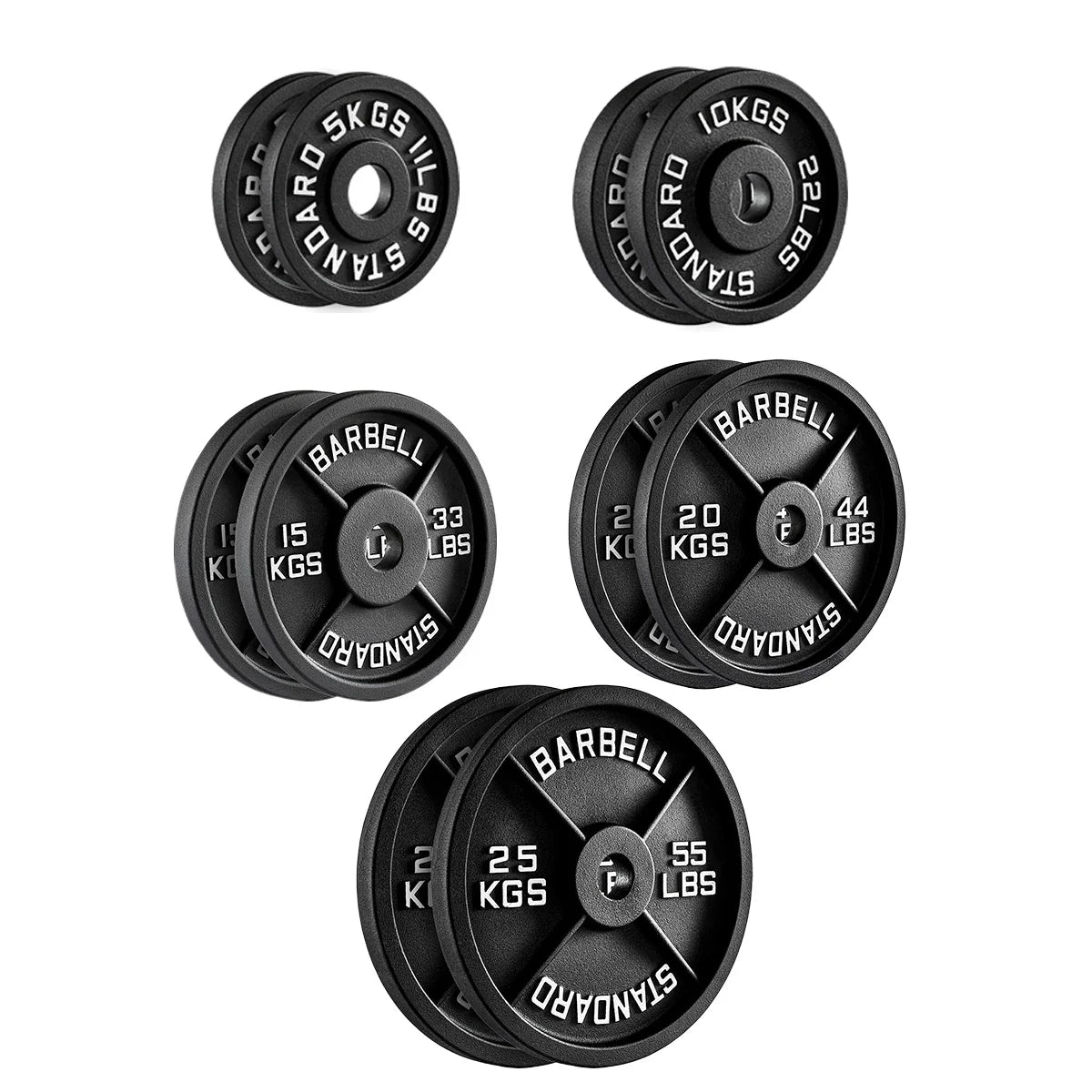
Machined cast iron with a true Olympic two-inch bore. Cast iron remains the most cost-effective way to load a barbell heavily, because it is denser than rubber or urethane and therefore takes up less sleeve length for the same weight.
Plate thickness is the specification most people overlook and later regret. An Olympic 2" Barbell sleeve has a finite loadable length, and rubber-coated or bumper plates are considerably thicker per kilogram than bare cast iron. If you intend to squat or deadlift above roughly 150kg, cast iron plates are not just cheaper, they are the only way to physically fit the weight on the bar.
The bore is the other quality marker. A machined 50mm bore sits snugly on the sleeve without excessive play, which stops plates clattering on every rep and reduces wear on both plate and bar. Loose, poorly finished bores are the usual cause of the rattling you hear on cheap plates during a bench press.
Cast iron is the natural choice for slow, controlled strength work performed inside a rack: back squats, bench press, overhead press, bent-over rows and rack pulls. What cast iron should not do is get dropped from height. It does not absorb impact, so it will damage flooring, the bar and itself. For Olympic lifting or anything involving dropping the bar, bumper plates are the correct tool.
Choose cast iron if you train inside a rack, want maximum weight per pound spent, and expect to load heavily. Choose bumper plates if you deadlift from the floor without a rack, perform cleans or snatches, or train in a room where dropped weight is a concern. Many home gyms run a hybrid: bumpers for the first 20kg pair so the bar sits at the correct height from the floor, then cast iron for everything above.
Will these fit my barbell?
They fit any standard Olympic bar with a 50mm sleeve. They will not fit standard one-inch spinlock bars used in convertible dumbbell sets.
Can I drop cast iron plates?
No. Cast iron does not absorb impact and will damage your floor, your bar and the plates. Use bumper plates if dropping is part of your training.
Why are cast iron plates thinner than rubber ones?
Iron is far denser than rubber, so it needs less volume for the same mass. That means more weight fits on the loadable sleeve length.
Do I need collars?
Yes. Always secure loaded plates with spring collars or quick-release collars, particularly on bench press and overhead work.
Plate Dimensions:
Key Features:
| Variant | Weight (each) | Pair total | Price | Availability | SKU | GTIN | Description |
|---|---|---|---|---|---|---|---|
| Cast Iron Olympic Weight Plates Pair 2 x 1.25kg, 2 inch Bore | 1.25 KG | 2.5 kg | £8.49 | In stock | CI-PLT-1.25KG-NB-P | 5299466727933 | DescriptionThis pair of 1.25kg cast iron weight plates is ideal for gradual strength progression and precise load increases. |
| Cast Iron Olympic Weight Plates Pair 2 x 2.5kg, 2 inch Bore | 2.5 KG | 5 kg | £12.49 | In stock | CI-PLT-2.5KG-NB-P | 5299467577254 | DescriptionThis pair of 2.5kg cast iron weight plates is ideal for gradual strength progression and precise load increases. |
| Cast Iron Olympic Weight Plates Pair 2 x 5kg, 2 inch Bore | 5.0 KG | 10 kg | £20.49 | In stock | CI-PLT-5KG-NB-P | 5299467974442 | DescriptionThis pair of 5kg cast iron weight plates is ideal for gradual strength progression and precise load increases. |
| Cast Iron Olympic Weight Plates Pair 2 x 10kg, 2 inch Bore | 10.0 KG | 20 kg | £39.99 | In stock | CI-PLT-10KG-NB-P | 5299468598128 | DescriptionThis pair of 10kg cast iron weight plates is ideal for gradual strength progression and precise load increases. |
| Cast Iron Olympic Weight Plates Pair 2 x 15kg, 2 inch Bore | 15.0 KG | 30 kg | £63.99 | In stock | CI-PLT-15KG-NB-P | 5299468639340 | DescriptionThis pair of 15kg cast iron weight plates is ideal for gradual strength progression and precise load increases. |
| Cast Iron Olympic Weight Plates Pair 2 x 20kg, 2 inch Bore | 20.0 KG | 40 kg | £79.99 | In stock | CI-PLT-20KG-NB-P | 5299468865688 | DescriptionThis pair of 20kg cast iron weight plates is ideal for gradual strength progression and precise load increases. |
| Cast Iron Olympic Weight Plates Pair 2 x 25kg, 2 inch Bore | 25.0 KG | 50 kg | £99.99 | In stock | CI-PLT-25KG-NB-P | 5299469415288 | DescriptionThis pair of 25kg cast iron weight plates is ideal for gradual strength progression and precise load increases. |
| Cast Iron Olympic Weight Plates 15kg Set, 2 inch Bore | 15KG Set | 15 kg | £31.99 | In stock | CI-PLT-15KG-NB-SET | 5299469614360 | DescriptionThis set of 15kg cast iron weight plates is ideal for gradual strength progression and precise load increases. |
| Cast Iron Olympic Weight Plates 45kg Set, 2 inch Bore | 45KG Set | 45 kg | £82.99 | In stock | CI-PLT-45KG-NB-SET | 5299469633545 | DescriptionThis set of 45kg cast iron weight plates is ideal for gradual strength progression and precise load increases. |
| Cast Iron Olympic Weight Plates 60kg Set, 2 inch Bore | 60KG Set | 60 kg | £110.49 | In stock | CI-PLT-60KG-NB-SET | 5299469719119 | DescriptionThis set of 60kg cast iron weight plates is ideal for gradual strength progression and precise load increases. |
| Cast Iron Olympic Weight Plates 75kg Set, 2 inch Bore | 75KG Set | 75 kg | £137.99 | In stock | CI-PLT-75KG-NB-SET | 5299470268248 | DescriptionThis set of 75kg cast iron weight plates is ideal for gradual strength progression and precise load increases. |
| Cast Iron Olympic Weight Plates 100kg Set, 2 inch Bore | 100KG Set | 100 kg | £183.99 | In stock | CI-PLT-100KG-NB-SET | 5299470281230 | DescriptionThis set of 100kg cast iron weight plates is ideal for gradual strength progression and precise load increases. |
| Cast Iron Olympic Weight Plates 150kg Set, 2 inch Bore | 150KG Set | 150 kg | £275.99 | In stock | CI-PLT-150KG-NB-SET | 5299471393833 | DescriptionThis set of 150kg cast iron weight plates is ideal for gradual strength progression and precise load increases. |
Wording shared by more than one row above, printed once here rather than repeated in every row.
| Weight | Diameter | Thickness | Sleeve |
|---|---|---|---|
| 1.25 kg | 160 mm | 12.4 mm | 50 mm |
| 2.5 kg | 230 mm | 16.2 mm | 50 mm |
| 5 kg | 230 mm | 21.7 mm | 50 mm |
| 10 kg | 270 mm | 34.4 mm | 50 mm |
| 15 kg | 350 mm | 34.4 mm | 50 mm |
| 20 kg | 450 mm | 33.6 mm | 50 mm |
| 25 kg | 450 mm | 36.6 mm | 50 mm |
Yes. A common set-up is one pair of 20 kg or 25 kg bumpers innermost to put the bar at the correct height from the floor, with cast iron loaded outside them for heavier sets. All Lift Sets plates share the 50 mm bore.
15 kg set: 4 x 1.25 kg and 4 x 2.5 kg. 45 kg set: 4 x 1.25, 4 x 2.5, 2 x 5 and 2 x 10 kg. 60 kg set: 2 x 5, 2 x 10 and 2 x 15 kg. 75 kg set: 4 x 1.25, 4 x 2.5, 2 x 10 and 2 x 20 kg. 100 kg set: 2 x 5, 2 x 10, 2 x 15 and 2 x 20 kg. 150 kg set: 2 x 5, 2 x 10, 2 x 15, 2 x 20 and 2 x 25 kg.
The 15 kg, 45 kg and 75 kg sets each include four 1.25 kg and four 2.5 kg plates. The 60 kg, 100 kg and 150 kg sets start at 5 kg pairs, so add change plates if you want 2.5 kg jumps on the bar.
Yes. Each plate has a stainless steel insert with a precision-machined 50 mm bore that sits snugly on an Olympic sleeve, which stops plates rattling on every rep and reduces wear on the plate and the bar.
Black powder-coated cast iron with silver lettering. The finish protects the iron, but the plates are not made to be dropped and rust from wet storage is not covered by the warranty.
Yes. Choose Pairs and a weight from 1.25 kg to 25 kg to get two plates, or choose Sets for a graded set from 15 kg to 150 kg. Prices are shown on the product page.
Iron is denser than rubber, so a cast iron plate is thinner per kilogram: the 25 kg plate is 36.6 mm thick against 60 mm for the rubber tri-grip and 81 mm for the bumper. On a 39 cm sleeve that is the difference that lets you fit a heavy squat or deadlift on the bar.
Delivery, returns and warranty are answered in full on the delivery page, in the Help centre and on the warranty page.
| Category | Free weights |
|---|---|
| Term | Statutory rights apply; manufacturer terms confirmed on request |
| Covers | Casting defects, coating that lifts or cracks without impact, handles that come loose from the head, adjustable mechanisms that fail under normal use. This guarantee is given by LIFT SETS LTD, Unit at St. Helens, Merseyside, and does not affect your statutory rights under the Consumer Rights Act 2015. |
| Not covered | Chips and scuffs from dropping, rust from wet storage, cosmetic marks, use in commercial settings unless quoted. Exclusions never remove your statutory rights: a fault that was present at delivery is covered whatever the exclusions say. |
| How to claim | Email support@liftsets.co.uk with your order number, a description of the fault and two or three photos or a short video. We reply with the next step: replacement part, repair, replacement or refund. Damage or shortages on arrival are a delivery claim, not a warranty claim: tell us as soon as you can. |
Your statutory rights under the Consumer Rights Act 2015 apply in full: up to 30 days to reject a faulty item for a refund, then repair or replacement, and for six months a fault is presumed to have been present at delivery. Full details: Warranty.
From £7.99
£6.99
From £10.99